

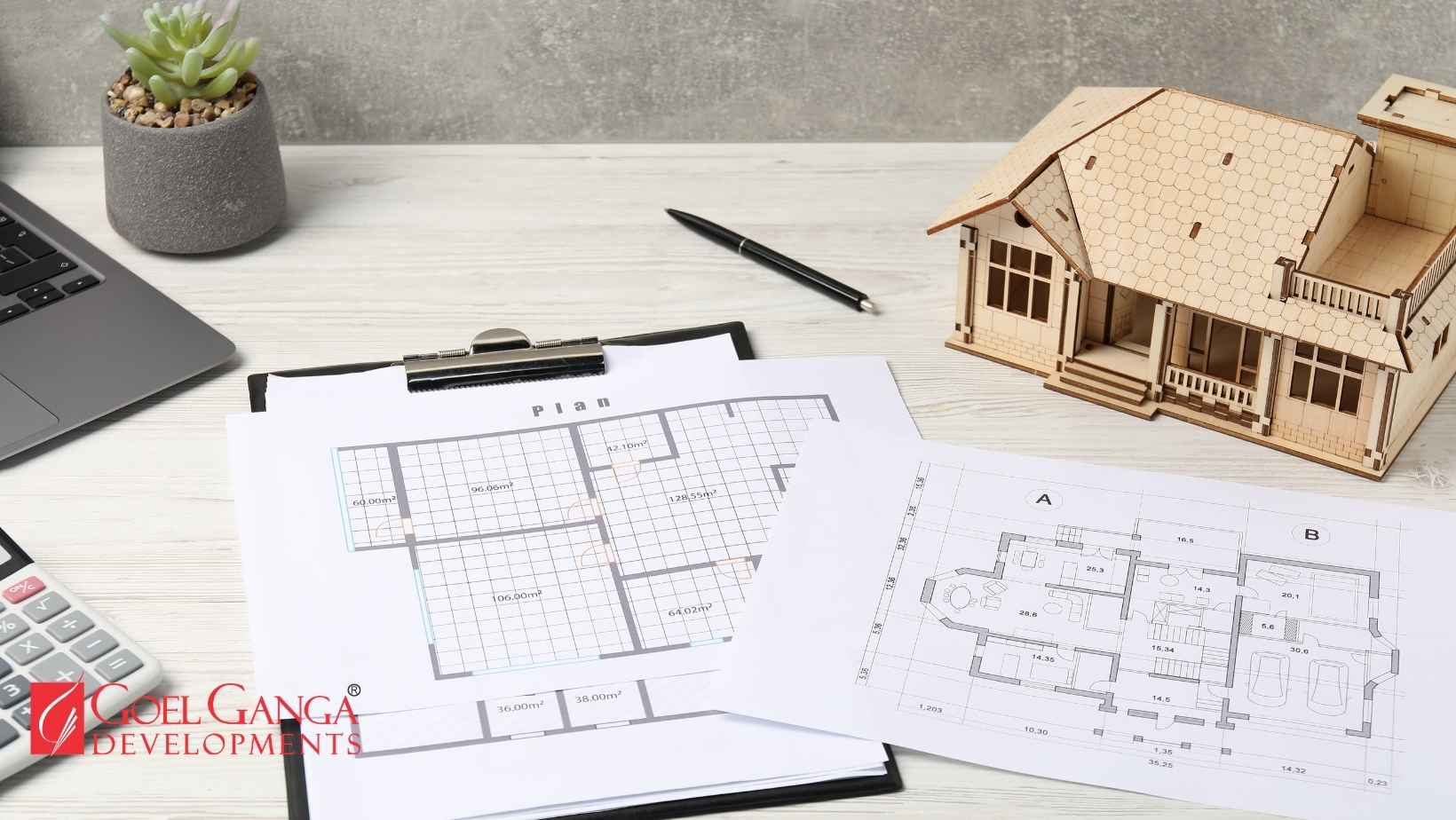
Buying a home is one of life’s most significant milestones. When you visit a premium project by Goel Ganga Developments, you are often presented with a colorful brochure featuring a floor plan—a technical drawing showing a bird’s-eye view of your potential future life.
At first glance, it looks simple: a few rectangles, some doors, a balcony, and room labels. However, that drawing is often the difference between a home that feels effortless and one that quietly irritates you for years. Most buyers focus solely on the BHK count and the total square footage. But “Total Area” doesn’t tell the whole story.
To find a home that truly fits your lifestyle, you need to learn how to “read between the lines.” Here is your comprehensive guide to decoding floor plans and making a choice you’ll love for decades.
Table of Contents
Toggle1. Look Beyond the Labels: The Geometry of Space
A room labeled “Master Bedroom” might look spacious on paper, but its utility depends entirely on its shape. Efficient homes usually have clean, rectangular, or square room shapes.
Be wary of L-shaped rooms or odd angles. While they might look “unique” on a plan, they often result in “dead space” where furniture cannot be placed. At Goel Ganga Developments, we prioritize efficient floor plate design, ensuring that every square foot you pay for is a square foot you can actually use.
2. Identify the “Circulation Tax”
Every home has a “circulation tax”—the space dedicated solely to moving from one room to another (corridors, passages, and foyers).
The Compact Plan: Minimizes hallways so that more area is allocated to your living and bedrooms.
The Weak Plan: Features long, narrow passages that eat into your carpet area without adding any functional value.
When reviewing a plan, trace the path from the front door to the kitchen or bedrooms. If you find yourself “traveling” through long internal corridors, you are paying for space you can’t live in.
3. Trace Your “Daily Route Map”
Instead of looking at the plan as a static image, imagine it as a movie of your daily life. Use your finger to trace these common routes:
The Grocery Run: From the main entrance to the kitchen. Is it a direct path, or do you have to navigate through the entire living room with heavy bags?
The Midnight Path: From the bedroom to the bathroom. Is it private, or is the path visible from the living room?
The Hosting Flow: From the kitchen to the dining area. Is the transition seamless for serving guests?
4. The “Second Bedroom” Reality Check
In the modern era, the second bedroom is rarely just a guest room. It’s a home office, a study for kids, or a hobby room.
Check if the second bedroom can realistically fit a standard bed, a wardrobe, and a desk. If the floor plan shows a bed but no wardrobe wall, that room will feel cramped once you move in. A usable second room is a major factor in both daily comfort and future resale value.
5. Kitchen Ergonomics: The Golden Triangle
A kitchen can be large but still frustrating to use. Architects look for the “Work Triangle”—the distance between the stove, the sink, and the refrigerator.
The Utility Area: Does the kitchen have a dedicated dry balcony or utility area? Without this, your washing machine and cleaning supplies will clutter your main cooking space.
Counter Continuity: Look for long, unbroken counter spaces. If the counter is chopped into small bits by the sink or hobs, your meal prep will feel chaotic.
6. Privacy Zoning: Active vs. Quiet Areas
One of the hallmarks of a well-designed Goel Ganga home is the separation of “Social” and “Private” zones.
- Public Zone: Living room, dining area, and guest bathroom.
- Private Zone: Bedrooms and attached toilets.
If a bedroom door opens directly into the living room, your privacy is compromised every time you have guests. Look for a small lobby or a “buffer” that shields the bedroom entrances from the sightlines of the main sitting area.
7. The Depth of the Balcony
Balconies are often the most marketed feature of a home, but their utility depends on depth, not just length.
A balcony that is only 3 feet wide is essentially a “standing balcony”—you can’t comfortably place a chair and a coffee table there. Look for balconies with a depth of at least 4.5 to 5 feet to ensure they become an extension of your living space rather than just a ledge for plants.
8. Door Swings and Furniture Placement
This is a detail most people miss. Look at the arcs on the floor plan—these represent door swings.
Do two doors clash if they are opened at the same time?
Does the bedroom door swing open in a way that blocks where your wardrobe should be?
Is there a clear wall for the TV unit in the living room that doesn’t face a window (which causes glare)?
9. Ventilation and Natural Light
While a 2D floor plan doesn’t show the sun, it does show window placement.
Cross Ventilation: Look for windows on opposite or adjacent walls. This allows air to flow through the home, keeping it cool.
Internal Rooms: Be cautious of rooms that only have a window opening into a small internal “duct.” These rooms will likely be dark and require artificial lighting even during the day.
10. What the Floor Plan Doesn’t Tell You
Even the best floor plan has limitations. To get the full picture, you must ask your sales manager about:
The View: Which way does the balcony face? Is there another tower blocking your view?
Floor Height: Higher floors usually offer better light and less noise but may have different pricing.
Proximity to Utilities: Is the apartment right next to the elevator shaft or the garbage collection point? (Potential noise and odor issues).
Conclusion: Designing Your Future
At Goel Ganga Developments, we believe that a home should be more than just a set of dimensions; it should be a sanctuary that supports your lifestyle. Our floor plans are crafted with a “Human-First” approach, focusing on light, air, and the intuitive flow of movement.
The next time you hold a floor plan, don’t just look at the numbers. Imagine your morning coffee, your evening relaxation, and your family gatherings. If you can see your life flowing smoothly through those lines and shapes, you’ve found your perfect home.
Ready to see these plans in person? Visit our latest projects today and experience the Goel Ganga difference in design and craftsmanship.