

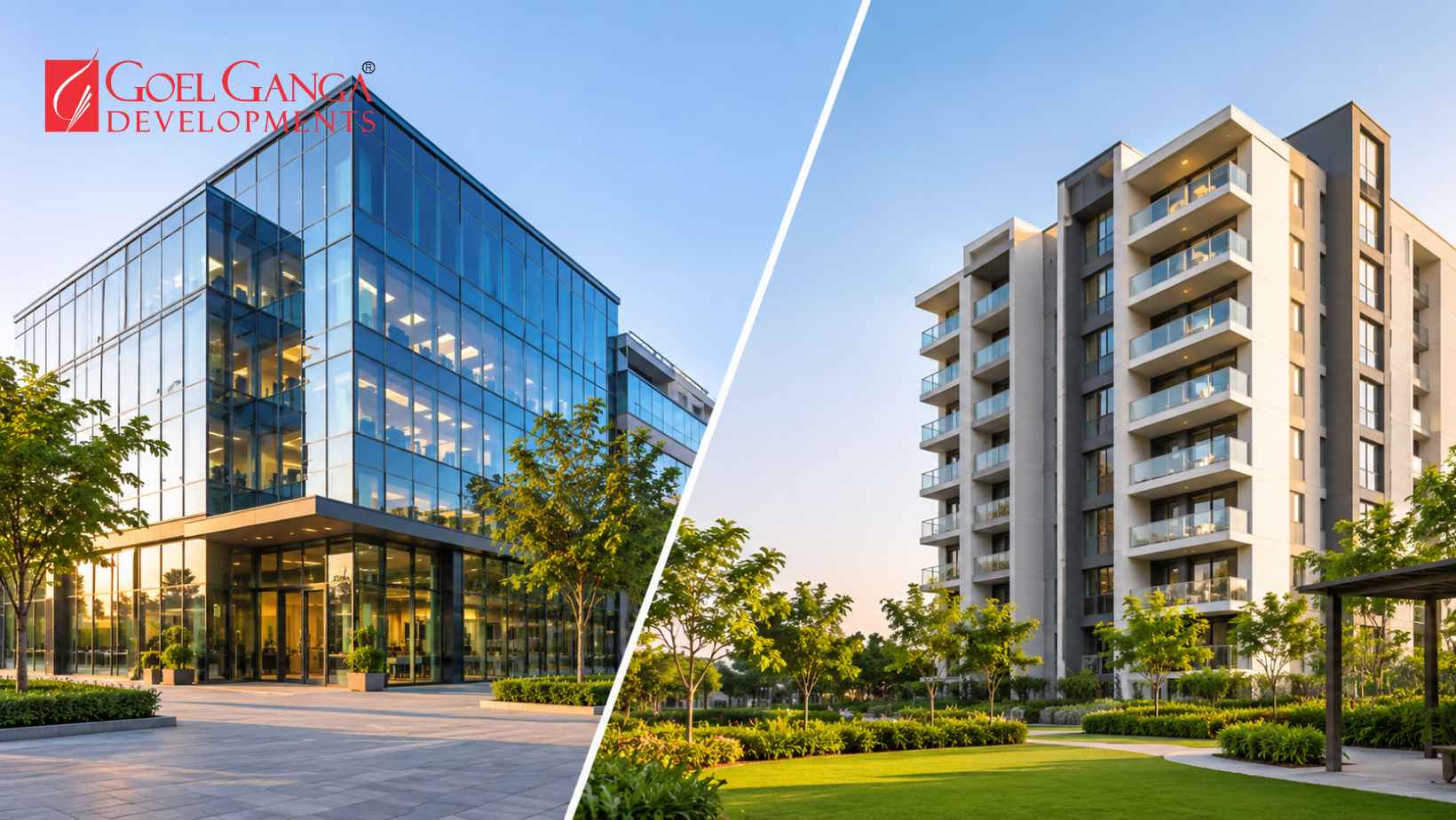
The real estate market continues to evolve, creating new opportunities for investors looking to build long-term wealth. However, one question remains important for anyone planning to invest in property: Commercial vs Residential Real Estate – which offers better returns, stability and growth opportunities in 2027?
Both property segments have their advantages. Commercial real estate attracts investors looking for rental income from offices, retail spaces and business establishments, while residential real estate appeals to those seeking long-term appreciation, rental opportunities and the security of owning a home.
In a growing city like Pune, where infrastructure development, employment opportunities and urban expansion continue to influence property demand, choosing between commercial and residential property requires careful consideration.
The right investment is not necessarily the one with the highest possible returns. It is the one that aligns with your financial goals, investment horizon, risk appetite and expectations.
Let’s understand how these two segments compare and which could be a better real estate investment in 2027.
Table of Contents
ToggleUnderstanding Commercial vs Residential Real Estate
Before deciding where to invest, it is important to understand what separates commercial and residential properties.
Commercial real estate refers to properties primarily used for business and income-generating activities. These include office spaces, retail shops, showrooms, commercial complexes, co-working spaces and other business establishments. Investors generally purchase these properties to earn rental income or benefit from capital appreciation.
Residential real estate, on the other hand, includes properties designed for people to live in. Apartments, flats, villas, row houses and residential developments fall under this category. These properties can serve as personal homes or investment assets that generate rental income.
The fundamental difference lies in their purpose. Commercial properties are primarily linked to business activity and commercial demand, whereas residential properties are driven by housing requirements, lifestyle preferences, affordability and population growth.
Both segments can offer attractive investment opportunities, but their performance depends on different market conditions.
1. Rental Income: Which Property Offers Better Returns?
Rental income is one of the biggest factors investors consider when comparing commercial vs residential real estate.
Commercial properties can potentially generate higher rental yields than residential properties. Businesses often enter into longer lease agreements, particularly for established office spaces and retail locations. This can provide investors with a relatively predictable rental income when the property is occupied and the tenant is financially stable.
However, commercial properties may also experience longer vacancy periods. Finding the right business tenant can take time, especially when the property is located in an area with limited commercial demand.
Residential properties generally offer comparatively lower rental yields, but they benefit from a broader tenant market. Working professionals, students, families and individuals relocating for employment create consistent housing requirements across many urban locations.
In Pune, the presence of IT parks, educational institutions, healthcare facilities and manufacturing hubs supports demand for rental accommodation in several residential micro-markets.
What should investors choose?
If your priority is potentially higher rental income and you can manage longer vacancy periods, commercial property may be worth considering. If you prefer an asset with a wider tenant base and relatively accessible rental demand, residential property can be a suitable option.
It is important to compare actual rental yields after accounting for maintenance, property taxes, vacancy, brokerage and other ownership expenses rather than relying only on advertised rental figures.
2. Initial Investment and Affordability
The initial investment required is another important difference between commercial and residential real estate.
Commercial properties, particularly offices and retail spaces in established business districts, can require substantial capital. Apart from the purchase price, investors may need to account for fit-outs, maintenance charges, registration costs and periods without rental income.
Residential properties offer a wider range of investment options. Buyers can choose from compact apartments, 2 BHK flats, larger family homes and premium residential developments depending on their budget.
This makes residential real estate relatively accessible to first-time property investors and individuals planning to purchase their first investment property.
In Pune, residential markets across locations such as Kharadi, Baner, Hinjawadi, Wakad, Mundhwa and Satara Road offer different price points and housing options. The right choice depends on connectivity, social infrastructure, employment hubs and the development potential of the surrounding neighbourhood.
For investors entering the property market in 2027, understanding the total cost of ownership is just as important as selecting the property type.
3. Risk and Market Stability: Commercial vs Residential Property
Every real estate investment involves risk. However, the nature of that risk differs between commercial and residential properties.
Commercial real estate is closely connected to business performance, corporate expansion, retail activity and economic conditions. If businesses reduce operations, relocate or downsize, commercial property owners may face vacancies and rental income disruptions.
The location and quality of the property also play a significant role. A commercial space in a well-connected business district with strong tenant demand may perform differently from one in an emerging location with limited commercial activity.
Residential real estate is influenced by housing demand, employment opportunities, household formation, affordability and infrastructure development.
People continue to require housing regardless of short-term business cycles. However, this does not mean residential property prices or rental income are guaranteed to remain stable. Oversupply, affordability challenges and weak local demand can affect residential investments too.
For investors prioritising long-term ownership and a relatively broad end-user market, residential real estate may offer a more familiar entry point. Commercial property may be appropriate for those comfortable with business-linked market risks.
4. Capital Appreciation: Which Property Has Better Growth Potential?
Capital appreciation refers to the increase in a property’s market value over time. It is one of the primary reasons people invest in real estate.
Both commercial and residential properties can appreciate, but their growth is influenced by different factors.
Commercial property values are often influenced by business expansion, corporate leasing activity, infrastructure, footfall and the availability of quality commercial spaces. Properties located near established business districts, transport networks and employment centres may benefit from growing demand.
Residential property appreciation is influenced by neighbourhood development, connectivity, lifestyle infrastructure, employment opportunities and housing demand. Locations that offer convenient access to schools, hospitals, shopping centres and workplaces can become increasingly attractive to homebuyers.
For Pune, infrastructure development and employment corridors remain important factors shaping property demand.
Areas such as Hinjawadi, Baner, Wakad, Kharadi, Hadapsar and Mundhwa have experienced development supported by their connectivity and proximity to business and employment hubs.
For a long-term investor, the surrounding area’s development potential can be just as important as the property itself.
5. Pune Real Estate Market Outlook for 2027
Pune continues to be an important real estate market in Maharashtra, supported by its IT industry, manufacturing ecosystem, educational institutions and growing urban population.
The city’s residential and commercial property markets are influenced by the expansion of employment centres, infrastructure improvements and changing buyer preferences.
Recent market research provides useful indicators for understanding the direction of the market.
According to ICRA’s February 2026 assessment, Pune was expected to remain India’s fifth-largest residential market among the top seven cities in FY2026. The agency projected residential launches to recover by 7–10% in FY2027, while property sales were expected to remain broadly stable, with a possible marginal decline of 0–3%. This indicates a market entering a more measured growth phase rather than one driven entirely by rapid expansion.
ICRA An Affiliate of Moody’s
The commercial property market also presents opportunities. Pune’s office sector has benefited from demand from IT, technology, Global Capability Centres (GCCs), BFSI and other corporate occupiers.
According to Cushman & Wakefield’s September 2026 Pune MarketBeat, the city recorded approximately 1.99 million sq. ft. of office leasing in Q3 2026, with GCCs accounting for around 65% of demand. This highlights the importance of Pune as a commercial and employment destination.
Cushman & Wakefield
Residential demand is also evolving. Buyers are increasingly evaluating the quality of construction, amenities, connectivity, community infrastructure and the long-term liveability of a neighbourhood before purchasing a home.
For 2027, investors should therefore look beyond broad market predictions. The performance of individual properties will depend on their location, pricing, developer credibility, construction quality and actual demand.
6. Why Pune Is an Important City for Both Commercial and Residential Investments
One of Pune’s biggest strengths is the presence of diverse economic and employment sectors.
The city has developed into an important destination for IT companies, automobile manufacturers, engineering businesses, educational institutions and multinational organisations. This economic diversity supports demand for both commercial spaces and residential properties.
For commercial investors, areas close to established employment hubs can offer opportunities to cater to businesses looking for office spaces, retail establishments and professional work environments.
For residential investors, the same employment ecosystem creates demand for apartments and homes from professionals, families and individuals relocating to Pune.
The relationship between commercial and residential development is particularly important. When a business district expands, nearby residential locations may become more attractive because people prefer homes that reduce commuting time and provide convenient access to workplaces.
However, proximity alone does not guarantee appreciation. Buyers should also evaluate traffic conditions, actual travel times, public transport, available social infrastructure and the supply of competing properties.
This is why understanding the micro-market is essential before making a property investment decision.
7. Factors to Consider Before Investing in Commercial or Residential Property in 2027
Choosing between commercial and residential real estate should begin with a clear understanding of your investment objectives.
If you are looking for regular rental income, evaluate the rental demand in the selected location. For commercial properties, research the types of businesses operating nearby, existing vacancies, tenant profiles and lease conditions. For residential properties, understand the demand from working professionals, families and students.
Your investment budget also matters. Avoid stretching your finances simply to purchase a larger property or one in a premium location. Consider the down payment, loan obligations, registration expenses, maintenance and potential vacancy periods.
The credibility of the developer should be another important consideration. Review the developer’s track record, completed projects, construction standards, delivery history and applicable approvals. Check the project’s RERA registration and relevant legal documentation before committing to a purchase.
Location deserves equal attention. A property with good connectivity, established infrastructure and access to essential facilities may have stronger long-term appeal than one that depends entirely on proposed developments.
Finally, calculate your expected returns realistically. Do not make an investment decision based only on projected appreciation or promised rental yields. Consider the total acquisition cost, ongoing expenses, taxation, financing costs and the time required to sell the property.
8. Commercial vs Residential Real Estate: Which Is Better for Different Types of Investors?
There is no single answer that works for every investor.
For first-time investors, residential real estate may be a more familiar starting point. The demand for housing is relatively broad, and residential properties can be purchased for personal use as well as rental income.
For investors with larger budgets and experience managing property assets, commercial real estate may offer opportunities to earn rental income from businesses. However, tenant selection, lease management and vacancy risks require careful attention.
For long-term wealth creation, both segments can play an important role. Residential property can provide exposure to housing demand and neighbourhood development, while commercial property offers exposure to business activity and the demand for organised workspaces.
Some investors may also consider diversifying across both property categories rather than depending entirely on one segment. The right approach will depend on available capital, liquidity requirements and risk tolerance.
So, Which Is the Better Investment in 2027: Commercial or Residential Real Estate?
The answer depends on what you want your property investment to achieve.
If your priority is potentially higher rental yields, longer lease arrangements and exposure to business growth, commercial real estate may be worth exploring. However, it generally requires careful tenant evaluation, a suitable location and the financial capacity to manage vacancies.
If your objective is long-term ownership, a wider end-user market and the flexibility to use the property as a home or rental asset, residential real estate may be more appropriate.
For investors exploring opportunities in Pune, both segments deserve attention in 2027. The city’s evolving commercial ecosystem, infrastructure development and housing demand create opportunities across different property categories.
At Goel Ganga Developments, the focus is on creating thoughtfully planned real estate developments that respond to evolving urban needs. Whether you are exploring a home for your family or evaluating a property investment, choosing the right development, location and developer is an important part of making an informed decision.
Real estate investment is not simply about buying a property. It is about understanding its potential, evaluating the risks and making a decision that supports your financial goals over time.
Explore real estate opportunities with Goel Ganga Developments and take a more informed step towards your property investment journey.
Frequently Asked Questions (FAQs)
These questions are structured to address common search queries and improve the article’s chances of appearing in Google’s featured snippets and AI-generated search answers.
1. What is the difference between commercial and residential real estate?
Commercial real estate includes properties used for business purposes, such as offices, retail shops and commercial complexes. Residential real estate includes homes, apartments, flats and villas designed for people to live in. Commercial properties primarily generate income through business rentals, while residential properties can be used for personal living or rental income.
2. Is commercial real estate better than residential real estate in 2027?
Commercial real estate may offer higher rental yields, while residential real estate can provide broader end-user demand and greater flexibility. Neither is universally better. The right investment depends on the buyer’s budget, financial goals, location preference and risk tolerance.
3. Which property offers better rental income: commercial or residential?
Commercial properties generally have the potential to offer higher rental yields than residential properties. However, rental income depends on location, tenant demand, property quality and vacancy rates. Residential properties may offer a wider pool of potential tenants.
4. Is Pune a good city for real estate investment in 2027?
Pune offers opportunities in both residential and commercial real estate because of its IT sector, manufacturing industries, educational institutions and infrastructure development. However, investors should evaluate individual locations, property prices, demand and project credentials before investing.
5. What factors affect property appreciation in Pune?
Property appreciation in Pune is influenced by infrastructure development, connectivity, employment opportunities, neighbourhood growth, social amenities, housing demand, property supply and the quality of the development.
6. Is residential property a good investment for first-time buyers?
Residential property can be a suitable starting point for first-time investors because it offers the flexibility of personal use and rental income. Buyers should assess affordability, location, legal approvals, developer credibility and long-term maintenance costs.
7. What should I check before investing in a commercial property?
Before investing, evaluate the property’s location, business demand, expected rental yield, tenant profile, vacancy levels, maintenance costs, lease terms, legal approvals and developer track record.
8. Can investors own both commercial and residential properties?
Yes. Investors can diversify their real estate portfolios by owning both commercial and residential properties. This can provide exposure to different income sources and market segments, although it also increases capital requirements and property management responsibilities.