
Pune’s real estate story in 2026 is no longer limited to Koregaon Park, Kalyani Nagar, Baner or other established neighbourhoods.
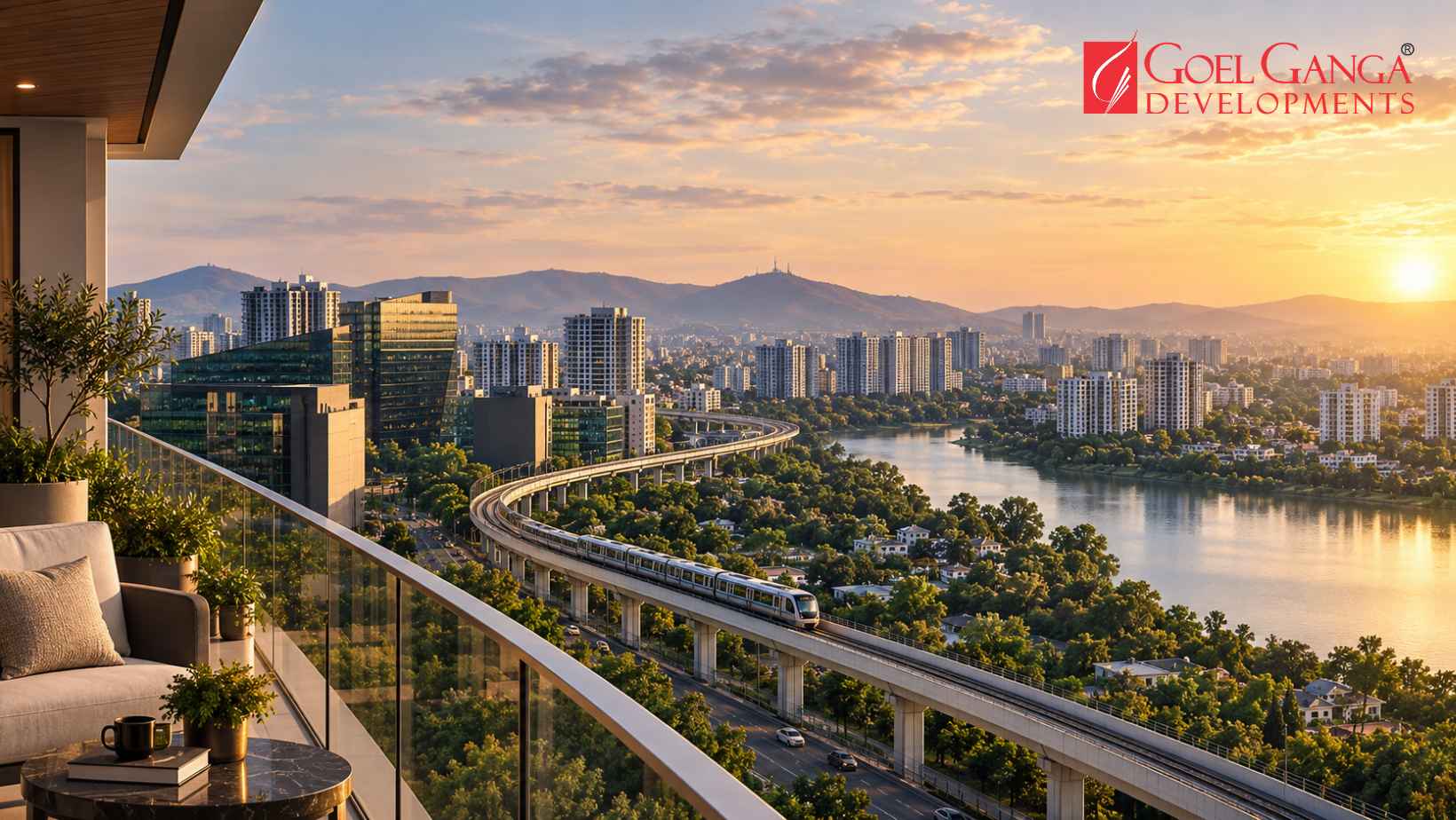
The city is expanding outward—and infrastructure is playing a major role in deciding where residential demand follows next.
New metro corridors, road connectivity, employment hubs, commercial development and planned infrastructure are changing the way people think about where to live in Pune. In many cases, homebuyers are looking beyond the traditional city centre and evaluating locations based on something much more practical:
“How easily can I get to work, school, the airport, the highway and the rest of the city from here?”
That question is increasingly shaping Pune’s residential market.
According to a recent 2026 review of Pune’s residential hotspots, the city recorded 24,890 housing sales in H1 2026, while developers launched 31,116 new homes, representing a 17% year-on-year increase. Average residential prices were reported at ₹10,063 per sq. ft., up 5% year-on-year.
But city-wide numbers only tell part of the story.
The more interesting story is happening at the micro-market level.
Here are seven Pune residential corridors worth watching in 2026—and the infrastructure and economic factors behind their growth.
Quick Answer: Which Pune Real Estate Hotspots Are Worth Watching in 2026?
If you are looking for the short answer, these are seven residential corridors attracting attention because of their combination of connectivity, employment and infrastructure:
- Hinjewadi–Maan – IT employment and Metro Line 3 connectivity
- Wakad–Tathawade – West Pune’s expanding residential corridor
- Kharadi–Wagholi – IT, commercial growth and Metro Phase 2
- Mundhwa–Hadapsar – Magarpatta Road – proximity to major employment and established infrastructure
- Baner–Balewadi–Mahalunge – established premium demand meeting expansion
- Punawale–Ravet – expanding residential development in West Pune
- Undri–Pisoli – growing southern residential belt with improving connectivity
The important point is that these locations should not be viewed simply as a list of “best areas.” Each has a different infrastructure story, buyer profile, price positioning and development stage.
Table of Contents
Toggle1. Hinjewadi–Maan: Where IT Employment Continues to Drive Housing Demand
For Pune’s residential market, few employment corridors have had as much influence as Hinjewadi.
The presence of Rajiv Gandhi Infotech Park has created a large employment catchment, and residential development has steadily expanded beyond the traditional Hinjewadi phases into Maan and surrounding areas.
That employment-residential relationship remains one of the biggest reasons the corridor continues to attract homebuyers.
Why is Hinjewadi–Maan growing?
The biggest catalyst is connectivity.
Pune Metro Line 3, connecting Hinjewadi and Shivajinagar, has been one of the major infrastructure projects associated with West Pune’s growth. PMRDA’s 2026 project information lists the 23-km Metro Line 3 among its major infrastructure projects, with operations targeted around March 2026.
This creates a broader connectivity story for people working in and around Hinjewadi.
The residential market has also expanded significantly, with townships, high-rise communities and mixed-use developments emerging across the wider Hinjewadi–Maan belt.
Who should consider this corridor?
- IT professionals
- Young families
- Buyers working in Hinjewadi
- Rental-property buyers
- Buyers looking for larger communities and newer developments
What should buyers check?
Don’t evaluate a property simply because it has “Hinjewadi” in its address.
Traffic conditions, actual distance from the workplace, access roads, public transport and the development stage of the surrounding area can make a significant difference.
2. Wakad–Tathawade: From Suburb to Established Residential Corridor
Wakad is no longer simply an alternative to central Pune.
Over the years, it has developed into a substantial residential and commercial ecosystem of its own, while Tathawade and Punawale have extended West Pune’s residential growth further.
The corridor benefits from proximity to Hinjewadi, Pimpri-Chinchwad and major road networks.
Why is Wakad–Tathawade attracting buyers?
One reason is its position between established urban infrastructure and emerging residential development.
Wakad provides access to an already-developed social ecosystem, while Tathawade has witnessed continued residential construction and newer housing formats.
The wider West Pune belt is also benefiting from Metro Line 3 and broader road infrastructure development.
What makes the corridor interesting?
For many buyers, it offers a middle ground:
Not quite the older city. Not quite the distant outskirts.
That balance is particularly relevant for families who want access to schools, retail, healthcare and employment hubs while still considering newer residential communities.
Suitable for:
First-time homebuyers
IT professionals
Young families
Buyers looking for newer residential projects
People working across Hinjewadi and Pimpri-Chinchwad
3. Kharadi–Wagholi: East Pune’s Infrastructure Story
If West Pune has Hinjewadi, East Pune has Kharadi.
Kharadi has emerged as one of Pune’s major employment and commercial destinations, particularly because of its large IT and business ecosystem.
Naturally, residential development has followed.
But the bigger story for 2026 is the relationship between Kharadi, Wagholi and future public transport connectivity.
Pune Metro’s Phase 2 includes the Ramwadi–Wagholi/Vitthalwadi corridor, covering 11.63 km with 11 stations. The planned corridor includes locations such as Viman Nagar, Kharadi Bypass, Upper Kharadi Road and Wagholi.
This is significant because Metro connectivity can influence how residential neighbourhoods relate to employment centres.
Why are buyers watching Kharadi–Wagholi?
The corridor brings together:
- IT and commercial employment
- Residential expansion
- Airport connectivity
- Existing road infrastructure
- Planned Metro connectivity
- Retail and lifestyle development
Wagholi also has a proposed multimodal hub under PMRDA’s infrastructure plans, forming part of a broader effort to improve regional transport connectivity.
But there is a catch. Growth does not automatically mean every project within a growth corridor will perform equally.
Buyers should examine: actual road access + infrastructure timeline + project quality + surrounding development + commute time.
The micro-location matters.
4. Mundhwa–Hadapsar: Established Connectivity Meets New Development
Mundhwa and Hadapsar sit within one of Pune’s most important eastern growth belts.
The appeal here is not purely about future infrastructure.
Unlike some emerging suburbs, parts of this corridor already have established residential, commercial and social infrastructure.
Hadapsar has long been associated with employment hubs and established residential communities, while Mundhwa has experienced significant redevelopment and new residential construction.
Why watch this corridor?
The area benefits from proximity to:
- Hadapsar
- Magarpatta
- Kharadi
- Koregaon Park
- Pune’s eastern employment hubs
This makes the corridor particularly relevant for buyers who want to remain connected to established parts of Pune while considering newer residential developments.
The buyer profile
This corridor can appeal to:
- Working professionals
- Families upgrading from older homes
- Buyers seeking proximity to East Pune employment hubs
- Buyers looking for premium and mid-to-premium housing
The biggest advantage here is arguably location efficiency.
You are not betting entirely on a future neighbourhood becoming established. Much of the surrounding ecosystem already exists.
5. Baner–Balewadi–Mahalunge: Premium Demand Moves Further West
Baner and Balewadi have already become established names in Pune’s premium residential market.
The next part of the story is Mahalunge and the wider western expansion. The evolution is easy to understand.
As established locations become denser and land becomes increasingly constrained, residential development naturally begins moving toward adjoining growth corridors.
Mahalunge benefits from its relationship with Baner, Balewadi and the wider Hinjewadi employment ecosystem.
Why does this matter?
Today’s homebuyer is increasingly looking for more than just an apartment.
They are evaluating:
- Commute
- Community
- Open spaces
- Amenities
- Schools
- Healthcare
- Retail
- Work-life convenience
This is one reason larger integrated developments and planned residential communities are becoming increasingly relevant in Pune’s expanding western suburbs.
Who may consider this corridor?
- Premium homebuyers
- Families
- Professionals working in West Pune
- Buyers looking for larger homes
- Buyers who want access to established Baner-Balewadi infrastructure without necessarily living in the core Baner market
6. Punawale–Ravet: West Pune’s Residential Expansion Continues
Move further west from Wakad and Tathawade, and the landscape changes.
Punawale and Ravet have become important residential growth corridors, with large-scale housing development reshaping areas that were once considered peripheral.
The attraction is relatively straightforward:
more development potential + proximity to employment corridors + access to major road networks.
Recent market reviews have identified Ravet–Tathawade among Pune’s active residential corridors, alongside Hinjewadi, Wakad, Baner, Kharadi, Wagholi, Hadapsar and Undri.
What is driving demand?
The wider West Pune ecosystem.
Residents can potentially access:
- Hinjewadi
- Wakad
- Pimpri-Chinchwad
- Mumbai–Pune connectivity
- Educational institutions
- Retail and social infrastructure
At the same time, new residential projects continue to add housing supply.
What should buyers consider?
This is an area where project-level due diligence becomes particularly important.
When a locality is developing rapidly, two projects only a few kilometres apart can offer very different experiences depending on:
- Road access
- Construction quality
- Water availability
- Public transport
- Existing social infrastructure
- Future development around the project
In emerging corridors, the neighbourhood outside your gate matters almost as much as the home inside it.
7. Undri–Pisoli: South Pune’s Expanding Residential Belt
South Pune is also part of the city’s outward residential expansion.
Undri and Pisoli have developed into established residential markets, particularly for buyers looking for relatively newer housing communities away from the central city. The corridor’s residential appeal comes from its proximity to areas such as Hadapsar, NIBM and Kondhwa, along with access to schools, retail and everyday amenities.
Why is it worth watching?
The story here is less about one single infrastructure project and more about gradual urban expansion. As Pune’s residential footprint grows, locations that were once considered peripheral increasingly become part of the city’s everyday housing market.
This is an important distinction.
Not every growth market needs a metro station or ring road immediately outside it. Sometimes growth happens because a neighbourhood gradually develops its own ecosystem.
Suitable for:
- Families
- First-time buyers
- Buyers looking for larger homes
- People working in South and East Pune
- Buyers comparing established suburbs with emerging residential locations
Why Infrastructure Matters So Much to Pune Real Estate
There is a simple relationship between infrastructure and real estate:
Better connectivity can make a location more accessible. Greater accessibility can attract businesses and residents. More residents can increase demand for housing and supporting infrastructure.
But the relationship isn’t automatic.
A proposed road does not instantly transform a neighbourhood.
A planned metro station does not mean every nearby project will benefit equally.
And an emerging locality can take years to develop a complete ecosystem.
That is why homebuyers should distinguish between three different stages:
1. Announced infrastructure
The project has been proposed or approved.
2. Under-development infrastructure
Construction, land acquisition or implementation is underway.
3. Operational infrastructure
The infrastructure is actually available for residents to use.
This distinction is especially important when evaluating property based on future connectivity.
For example, PMRDA’s current project information shows multiple road and connectivity projects at different stages, including land acquisition and construction.
Future infrastructure should therefore be treated as a potential catalyst—not as an existing amenity.
How Infrastructure Is Changing the Way Pune Homebuyers Choose a Location
Earlier, choosing a Pune home often meant asking:
“Which locality do I like?”
Today, the question is becoming:
“Which location works best for my lifestyle and commute?”
That shift is important.
A buyer working in Kharadi may value a home differently from someone working in Hinjewadi.
Family with children may prioritise schools and healthcare.
A frequent traveller may care more about airport access.
A rental-property buyer may focus on employment density and tenant demand.
So there isn’t one universally ideal Pune location.
There is only a location that fits a particular buyer’s requirements.
What Should You Check Before Buying Property in a Pune Growth Corridor?
Before getting carried away by words such as upcoming, future-ready or high-growth, ask these questions:
1. How much of the infrastructure actually exists today?
Don’t confuse a proposed project with an operational one.
2. What is the real commute?
Check the journey during peak hours—not just the distance on Google Maps.
3. Who will live and work around the project?
Employment hubs are particularly important because they can influence both housing demand and rental demand.
4. Is social infrastructure already available?
Look at schools, hospitals, supermarkets, restaurants and everyday services.
5. How much new housing is coming?
Rapid development can be positive, but large volumes of new supply can also create competition between projects.
6. What is the developer’s track record?
Look beyond the brochure. Check completed projects, delivery history, approvals and MahaRERA information.
7. What is the actual micro-location?
“Wagholi,” “Hinjewadi” or “Baner” can cover a surprisingly large area.
The five-minute location test is often more useful than the locality name.
The Bigger Picture: Pune Is Becoming a Network of Micro-Markets
Perhaps the biggest change in Pune’s real estate market is that the city is no longer behaving like one single property market.
Instead, it is becoming a collection of interconnected micro-markets.
West Pune has its Hinjewadi employment ecosystem.
East Pune has Kharadi and the wider Wagholi corridor.
South Pune continues to expand through Undri and surrounding areas.
Central and established premium markets remain important, while adjoining areas such as Mahalunge and Mundhwa continue to absorb new residential demand.
Infrastructure is helping connect these markets.
And that means the future Pune homebuyer may increasingly choose a location based not just on today’s neighbourhood—but on how the neighbourhood is likely to function as the city expands.
Frequently Asked Questions About Pune Real Estate in 2026
Which are the emerging real estate hotspots in Pune in 2026?
Hinjewadi–Maan, Wakad–Tathawade, Kharadi–Wagholi, Mundhwa–Hadapsar, Baner–Balewadi–Mahalunge, Punawale–Ravet and Undri–Pisoli are among the residential corridors attracting attention in Pune’s 2026 market.
Which Pune areas are benefiting from Metro development?
Several growth corridors are connected to current or planned Metro infrastructure. Pune Metro Phase 2 includes the Ramwadi–Wagholi/Vitthalwadi corridor, while Metro Line 3 connects Shivajinagar with Hinjewadi.
Is infrastructure important when buying property in Pune?
Yes, but it should be considered alongside current connectivity, employment opportunities, social infrastructure, project quality, supply and pricing. Future infrastructure should not be treated as guaranteed immediate appreciation.
Is Hinjewadi still a major residential market in Pune?
Yes. Hinjewadi continues to be a major employment-led residential corridor, supported by its IT ecosystem and connectivity improvements.
Which Pune areas are connected to the planned Metro expansion toward Wagholi?
The proposed Ramwadi–Wagholi/Vitthalwadi Metro corridor includes stations and connectivity around Viman Nagar, Kharadi Bypass, Upper Kharadi Road and Wagholi.
What should I check before buying property in an emerging Pune locality?
Check the property’s MahaRERA registration, developer track record, actual commute times, infrastructure status, social infrastructure, water and civic services, surrounding development and upcoming housing supply.
Final Takeaway
Pune’s next phase of residential growth is being shaped by more than new apartment launches. Infrastructure, employment and connectivity are increasingly determining where people choose to live. From Hinjewadi and Maan in the west to Kharadi and Wagholi in the east, and from Mundhwa–Hadapsar to Undri and Pisoli in the south, the city’s residential map is becoming broader and more interconnected.
But the smartest way to evaluate a Pune property is not simply to ask:
“Is this a hotspot?”
Ask instead:
“What is driving this location, how much of that infrastructure exists today, and does this micro-market fit the way I actually live?”
Because in Pune’s rapidly expanding real estate market, the locality matters—but the reason behind its growth matters even more.