

A property may be inherited by multiple legal heirs or jointly owned by family members. In some situations, one co-owner may decide not to retain their share in the property. A Relinquishment Deed, also commonly called a Release Deed, is a legal instrument used to formally give up or renounce a person’s rights or interest in a property in favour of another person who has a legal interest in it.
For families dealing with inherited property, succession, partition or joint ownership, understanding how a relinquishment deed works can help prevent future ownership disputes and make the transfer of rights more legally clear.
This guide explains the meaning of a relinquishment deed, when it is required, who can execute it, the registration process, documents required, stamp duty considerations and important precautions—with a focus on property transactions in Maharashtra.
Legal note: Property laws, stamp duties and registration charges can depend on the nature of the property, relationship between the parties and circumstances of the transfer. This article is for general information and should not be treated as legal advice. A property lawyer or registration professional should verify the applicable provisions before execution.
What Is a Relinquishment Deed?
A Relinquishment Deed is a legal document through which a person gives up or renounces their existing right, title or interest in a property in favour of another person who has a right or interest in that property. It is commonly used when property is jointly inherited by legal heirs.
Simple example
Suppose a father passes away leaving behind a house that is inherited by three legal heirs—two sons and a daughter.
If the daughter does not want to retain her share and wishes to give up her rights in favour of her brothers, she may execute a relinquishment or release deed, subject to the applicable succession and registration requirements. After the legally valid execution and registration of the deed, her relinquished interest can be dealt with according to the terms of the document and applicable law.
A relinquishment deed is therefore particularly relevant when multiple people have an existing legal interest in the same property.
Relinquishment Deed vs Release Deed
The terms “Relinquishment Deed” and “Release Deed” are often used interchangeably in property transactions.
The underlying concept is that one person gives up a claim or interest in property. Under Article 52 of the Maharashtra Stamp Act, a “Release” includes an instrument through which a person renounces a claim against another person or specified property.
The exact legal treatment, however, depends on the facts of the transaction, the nature of the property and the rights held by the parties.
When Is a Relinquishment Deed Used?
A relinquishment deed may be considered in situations such as:
- Inherited property being jointly held by several legal heirs
- One legal heir giving up their share in favour of another heir
- Family property where a co-owner wants to surrender their existing interest
- Settlement of ownership among family members
- Simplifying ownership of an inherited house, flat, land or other immovable property
- Family arrangements where one person does not wish to retain their existing share
It is important to establish that the person executing the deed actually has a legal right or interest that can be relinquished. A person generally cannot simply relinquish a property right that they never possessed.
Who Can Execute a Relinquishment Deed?
Typically, the person executing the document must have an existing legal right, title or interest in the property.
For example, depending on the circumstances, this may include:
- Legal heirs
- Co-owners
- Coparceners
- Family members who have inherited a share
- Other persons having a legally recognised interest in the property
Succession rules can vary depending on the applicable personal law, Will, nature of ownership and circumstances of inheritance. For example, under the Hindu Succession Act, daughters have the same rights as sons in Mitakshara coparcenary property, subject to the statutory provisions and relevant facts.
Therefore, the assumption that only sons or only male family members can relinquish or inherit property is incorrect.
How Does a Relinquishment Deed Work?
The process generally involves the following steps.
1. Establish ownership and legal rights
Before preparing the deed, determine:
- Who currently owns the property?
- How was the property acquired?
- Who are the legal heirs?
- Is there a registered Will?
- Has succession been established?
- What percentage or share does each person hold?
- Is the property ancestral, inherited, self-acquired or jointly purchased?
- Are there any existing loans, disputes or encumbrances?
This is one of the most important stages because the validity and applicable charges can depend on the underlying ownership structure.
2. Obtain the necessary property documents
The parties should collect relevant title and property records, such as:
- Previous sale deed or title document
- Registered Will, if applicable
- Death certificate of the deceased owner, where applicable
- Legal heir or succession-related documents, wherever required
- Property card or 7/12 extract, depending on the property
- Mutation records
- Identity and address proof of the parties
- Existing loan or encumbrance documents, if relevant
- Society or apartment-related documents, where applicable
The exact document list may vary from one transaction to another.
3. Draft the Relinquishment Deed
The deed should clearly identify:
- The person relinquishing the rights
- The person or persons in whose favour the rights are being relinquished
- Description of the property
- Existing ownership/share of the releasor
- Nature and extent of the relinquished interest
- Whether consideration is involved
- Relationship between the parties, where relevant
- Declaration regarding the rights being relinquished
- Other relevant terms and conditions
The property description should be sufficiently detailed to avoid ambiguity.
4. Determine applicable stamp duty
Stamp duty is an important consideration.
In Maharashtra, Article 52 of the Maharashtra Stamp Act specifically deals with release instruments. For qualifying releases concerning ancestral property executed by or in favour of specified close relatives, the statute provides a concessional stamp duty of ₹200, subject to the conditions prescribed by the law. In other cases, Article 52 provides for duty linked to the applicable conveyance duty on the market value of the share, interest, part or claim relinquished.
Therefore, there is no universal stamp-duty amount applicable to every relinquishment deed in Maharashtra.
The nature of the property, relationship between the parties and structure of the transaction should be checked before calculating the applicable duty.
5. Execute the document
The parties execute the deed in accordance with applicable legal requirements, generally in the presence of witnesses and before the appropriate registration authority where registration is required.
6. Register the deed
A document affecting rights in immovable property may require registration.
Section 17 of the Registration Act, 1908 sets out documents for which registration is compulsory, including instruments that create, declare, assign, limit or extinguish rights in immovable property. An unregistered document that is required to be registered generally cannot operate to affect such property in the manner contemplated by the law.
For this reason, simply signing a relinquishment document privately may not be sufficient to legally transfer or extinguish rights in immovable property.
Documents Required for a Relinquishment Deed
The exact requirements can vary, but commonly requested documents may include:
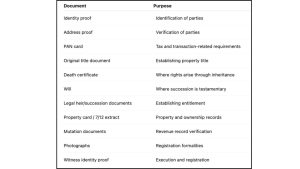
A registration office or legal professional may require additional documents depending on the transaction.
Is Registration of a Relinquishment Deed Mandatory?
Where the deed affects rights in immovable property and falls within the compulsory-registration provisions, registration is generally necessary.
The Registration Act, 1908 provides the statutory framework for compulsory registration of specified documents affecting immovable property.
This is particularly important because an unregistered document can create significant difficulties when a person later tries to establish ownership or mutation based on that document.
What Happens After Registration?
Once the deed has been validly executed and registered, the relevant property and revenue records may need to be updated.
Depending on the type of property, this could involve:
- Obtaining the registered deed.
- Submitting the necessary documents to the relevant authority.
- Applying for mutation or updating ownership records.
- Updating society or apartment records, where applicable.
- Updating municipal or revenue records as required.
- Preserving the registered document and supporting title records.
Registration itself and mutation are separate processes. A person should not assume that updating one record automatically completes every ownership-related formalisation.
Relinquishment Deed for Inherited Property
Inherited property is one of the most common contexts in which relinquishment deeds are considered.
For example:
A father dies intestate → four legal heirs inherit the property → one heir does not wish to retain their share → that heir may consider a legally valid release/relinquishment in favour of eligible co-heirs, subject to applicable law.
Before executing the deed, the family should first establish the legal heirs and their respective interests.
Where a Will exists, the position can be different. Similarly, ancestral property, coparcenary property and individually owned property can involve different legal considerations.
Relinquishment Deed vs Gift Deed
A relinquishment deed should not automatically be treated as a substitute for a gift deed.
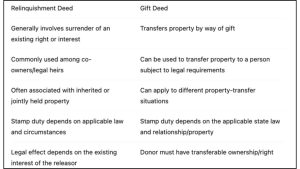
The correct document depends on the transaction.
For example, if a person who has no existing share in a property wants to transfer property to another person, a relinquishment deed may not be the appropriate instrument.
Relinquishment Deed vs Partition Deed
These documents also serve different purposes.
A partition deed generally deals with division of jointly held property among persons having rights in it.
A relinquishment deed, on the other hand, involves one person giving up their existing claim or interest.
For example:
Partition:
Three co-owners divide their property into separate shares.
Relinquishment:
One co-owner gives up their existing share in favour of another eligible co-owner.
The appropriate document should be selected after examining the actual ownership arrangement.
Can a Relinquishment Deed Be Cancelled?
A relinquishment deed should not be treated as a casual declaration that can simply be withdrawn later.
Once a person has legally and voluntarily relinquished their rights through a validly executed and registered document, reversing the transaction may involve significant legal complications.
If there are allegations of:
- Fraud
- Misrepresentation
- Undue influence
- Lack of free consent
- Forgery
- Incorrect understanding of the document
- Lack of legal capacity
the affected person may need to seek appropriate legal remedies.
Because cancellation or challenge can become complicated, legal review before signing is considerably safer than attempting to undo the transaction later.
Important Precautions Before Signing
Before executing a relinquishment deed, consider the following:
Verify the title
Confirm that the person relinquishing the share actually owns or legally possesses the interest being surrendered.
Understand the share
The deed should clearly state the nature and extent of the interest being relinquished.
Check for liabilities
Outstanding mortgages, loans, litigation, attachments or other encumbrances should be examined.
Understand consideration
Clearly establish whether the relinquishment is without consideration or involves any payment or other arrangement.
Check stamp duty
Do not rely on a generic online calculation. Maharashtra’s stamp-duty treatment can differ depending on the circumstances and applicable statutory provision.
Use accurate property details
Survey number, CTS number, flat number, area, boundaries and other identifying details should match the underlying title documents.
Take legal advice
A property lawyer should review the document where the title, succession or family arrangement is complicated.
Common Mistakes to Avoid
Some common mistakes include:
- Signing a deed without verifying the title
- Assuming every relinquishment attracts nominal stamp duty
- Using a relinquishment deed when a gift or conveyance may be appropriate
- Failing to identify all legal heirs
- Leaving the property description incomplete
- Ignoring existing mortgages or disputes
- Not registering a document where registration is legally required
- Failing to update relevant property records after registration
- Signing without understanding the legal consequences
These mistakes can lead to ownership disputes and difficulties during a future sale or transfer.
Frequently Asked Questions About Relinquishment Deeds
What is the meaning of a relinquishment deed?
A relinquishment deed is a legal document through which a person gives up or renounces their existing right, title or interest in a property in favour of another person with a relevant legal interest.
Is a relinquishment deed the same as a release deed?
The terms are commonly used interchangeably in property transactions. Maharashtra’s Stamp Act specifically uses the term Release under Article 52 for an instrument through which a person renounces a claim.
Can a legal heir relinquish their share in inherited property?
Yes, a legal heir may be able to relinquish their legally established share, subject to the applicable succession law, nature of the property and other legal requirements.
Is registration necessary?
Where the instrument falls under the compulsory-registration provisions applicable to rights in immovable property, registration is required. Section 17 of the Registration Act, 1908 is particularly relevant.
What is the stamp duty on a relinquishment deed in Maharashtra?
It depends on the circumstances. Under Article 52 of the Maharashtra Stamp Act, qualifying releases involving specified relatives and ancestral property can attract a concessional duty of ₹200, while other cases can attract duty based on the applicable conveyance provisions and the value of the relinquished interest.
Can I relinquish only my share in a property?
A person may be able to relinquish their existing share or interest rather than the entire property, provided the legal and factual circumstances permit it and the deed clearly identifies the interest being surrendered.
Is a relinquishment deed better than a gift deed?
Neither document is universally “better.” The appropriate instrument depends on whether the person is surrendering an existing right or transferring property by way of gift. Professional legal advice is recommended before choosing the document.
Read difference between gift deed and conveyance deed.
Conclusion
A Relinquishment Deed can be an effective legal instrument for simplifying ownership of inherited or jointly held property, particularly when one legal heir or co-owner does not wish to retain their existing share.
However, the process involves more than simply signing a document. The parties should verify the title, establish legal ownership and succession, draft the deed accurately, determine the applicable stamp duty, complete registration where required and update relevant property records.
For anyone dealing with inherited or jointly owned property in Maharashtra, taking professional legal guidance before executing a relinquishment deed can help avoid costly ownership disputes in the future.
Thinking About Buying a Home in Pune?
Understanding property documentation is an important part of making a confident real-estate decision. From title-related documentation to agreements and registration, buyers should evaluate every aspect of a property transaction carefully.
Explore thoughtfully. Choose confidently. Build your future with Goel Ganga Developments.
This article is intended for general educational purposes and does not constitute legal advice. Laws, stamp duties, registration fees and administrative procedures may change. Readers should verify the current applicable provisions with the relevant Maharashtra authorities or a qualified property-law professional before acting.